
Introduction
With the development of society, consumers have raised higher requirements for the barrier properties and safety of plastic packaging materials, especially in the food sector, where packaging must have excellent barrier performance. The increasing demand for product quality during shelf life has made barrier plastic packaging materials increasingly important in modern industries.
Advantages of PVDC Film Packaging
Generally, any packaging material used in normal applications can be considered a "high-barrier material," but there are very few polymers that truly qualify as barrier polymers. Barrier polymers typically contain one of the following functional groups: hydroxyl, nitrile, halogen, ester, or amide. Examples include PVDC, PA, and EVOH.
High-barrier packaging materials serve two key functions: they ensure product preservation and freshness, extending shelf life, and they enhance food safety by minimizing the risk of contamination and spoilage.
Understanding PVDC
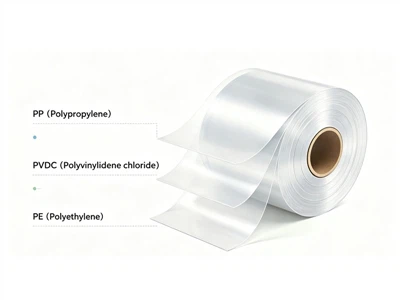
PVDC (Polyvinylidene Chloride) is recognized for its outstanding barrier properties. Compared to general plastic films, PVDC exhibits excellent oxygen, gas, and moisture barrier capabilities with low permeability.
PVDC is a thermoplastic resin with a softening temperature between 160°C and 200°C. It has a linear polymer chain structure where strong intermolecular cohesion and high crystallinity contribute to its excellent barrier performance. The chlorine atoms within PVDC molecules are hydrophobic and do not form hydrogen bonds, making it difficult for oxygen and water molecules to pass through.
Since its development, PVDC has been widely applied as a high-barrier material, though its adoption has been relatively slow due to processing challenges. However, with increasing demand for high-quality food packaging, PVDC remains a critical solution for ensuring product stability and safety.
Superior Performance of PVDC
PVDC is recognized as the most effective plastic barrier material. Unlike EVOH, which loses gas barrier properties as humidity increases, or nylon, which deteriorates due to water absorption, PVDC maintains stable moisture and gas barrier properties regardless of environmental conditions. This ensures consistent protection for packaged goods.
Experimental data show that PVDC's barrier performance is several times, dozens of times, or even hundreds of times better than conventional packaging materials.
|
Polymer |
Oxygen (cm³/m²·24h·atm) |
Nitrogen |
CO₂ |
Water Vapor (g/m²·24h) |
|
PVDC VC Type |
4-10 |
0.1-0.8 |
0.3-0.7 |
0.4-1.0 |
|
PA6 |
35 |
- |
43-59 |
93-155 |
|
PP |
300 |
60 |
1200 |
3.6-10.2 |
|
PET |
74-138 |
12-24 |
35-50 |
27.4-46.7 |
|
PVC |
77-310 |
- |
140-400 |
13.2-71.3 |
|
LDPE |
500-700 |
200-400 |
2000-4000 |
15.2-23.4 |
|
HDPE |
200-500 |
15-300 |
2000-4000 |
3.5-11.1 |
|
PAN |
11.6 |
- |
6 |
47 |
|
EVOH-44% |
1.8 |
1.13 |
1.4 |
95 |
(Film thickness: 25.4μm; Testing conditions: 23°C, 50% RH for gases; 38°C, 100% RH for water vapor)
Applications of PVDC in the Food Packaging Industry
PVDC offers several benefits for food packaging:
Convenience: Lightweight, high-barrier properties.
Consumer Demand: Transparent, glossy, and printable.
Food Safety: Reliable barrier properties approved for direct food and pharmaceutical contact.
Environmental Protection: Reduces packaging weight and simplifies packaging structure.
China's flexible packaging industry has recognized PVDC's oxygen and moisture barrier capabilities, but its aroma retention, anti-permeability, and oil resistance are often overlooked. These properties are crucial for ensuring product quality during transportation and storage.
With the rise of automated stretch packaging equipment, PVDC thermoforming film has gained popularity, expanding applications beyond sausage meat products to tofu, dairy, and instant foods that require high-barrier packaging.
Trends in PVDC Development in China's Food Packaging Industry
PVDC was introduced to China in the early 1990s and quickly gained popularity in meat packaging, particularly for high-temperature processed meat products. The growth of China's food industry is closely tied to advancements in packaging technology. Innovations in food production require improved packaging solutions. Therefore, the sustainable development of China's food industry relies on high-quality food products, advanced processing technologies, and safe, high-barrier packaging materials. Using PVDC for food packaging is not just about extending shelf life-it's about preserving product freshness and ensuring safety.
In recent years, with increasing consumer awareness of food safety and environmental protection, more flexible packaging manufacturers and food companies have favored PVDC for its superior barrier properties. As China's food industry continues to grow, PVDC is expected to play a crucial role in providing high-barrier, climate-resistant packaging solutions.