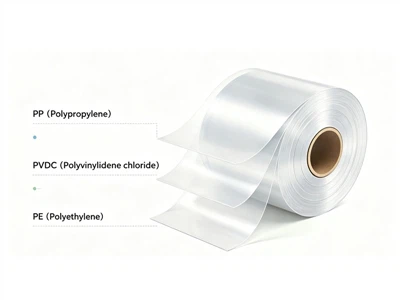

PVDC Film is an Excellent Material for High-Temperature Sterilized Sausage Casing
PVDC film meets all the necessary conditions for use as a casing, as demonstrated by the following characteristics:
①Excellent Mechanical Properties:
High tensile strength, elasticity, and toughness, with a soft texture, making it suitable for use in automatic filling machines.
②High Thermal Shrinkage Rate:
Ensures a dense internal structure of the sausage products.
③High Gas Barrier Properties:
Meat products packaged and sterilized with PVDC can be preserved for over 6 months at room temperature.
④High-Temperature Resistance:
Withstand cooking at 121°C for 40 minutes without deformation or rupture.
⑤Stable Chemical Properties:
Not react with acids, alkalis, salts, or food components to produce harmful substances.
Resistant to oils, solvents, and UV light, with low UV transmittance and slow aging. Not absorb or allow penetration of harmful substances.
⑥Excellent Food Safety:
The resin contains no toxic or harmful components, and no harmful additives are used during processing.
The film does not migrate substances that could negatively impact human health.
Approved by the FDA for long-term direct contact with food.
⑦Good Heat-Sealing Performance:
Available to be sealed using high-frequency current heating, with high seal strength that withstands high-temperature cooking without breaking.
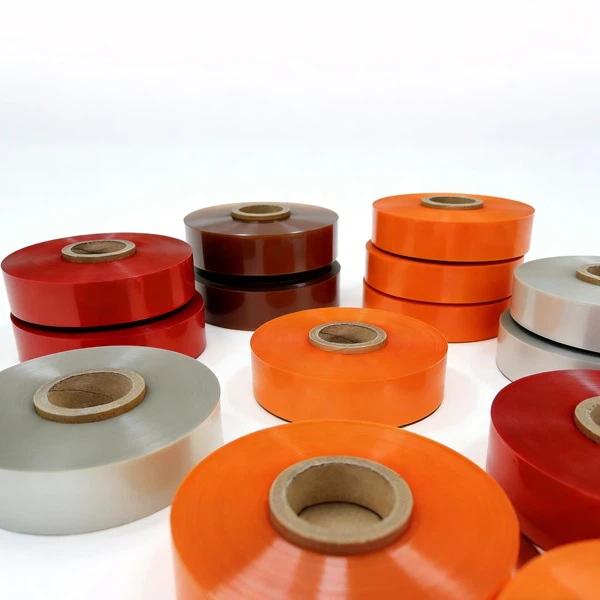
⑧Compatibility and Dispersion with Various Colors:
Available to be manufactured into films of various colors.
⑨Suitable for Printing:
The surface is ideal for printing.
⑩Abundant Resources and Consistent Product Specifications:
Meets the needs of large-scale industrial production.
Therefore, PVDC film is currently the only casing material that combines high barrier properties, high thermal shrinkage, and high-temperature resistance. It is also the only packaging material suitable for long-term storage of meat products at room temperature.
Properties Required for PVDC Film Used as Casing
Although PVDC film is theoretically the most excellent casing material, sheet casings must endure the most rigorous process tests during sausage production. This includes the ability to form smoothly on filling machines, achieve proper heat sealing, withstand high-temperature sterilization, and ensure that the meat products meet shelf-life requirements during long-term storage. Not all PVDC films are capable of meeting these demands. So, what specific properties must PVDC film possess to be suitable for use as casing?
The thickness of the film must be uniform.
Ordinary PVDC films are produced using the blown film process, which results in a thickness deviation of about ±8%. This range of thickness deviation is too large for use as casings. When the casing film has a significant thickness deviation, it can easily be misaligned during operation on automatic filling machines, affecting the shaping and heat sealing process. Additionally, a large thickness deviation can lead to uneven shrinkage when the casing is heated, resulting in inconsistent product sizes after sterilization and causing the casing to bend. If the thickness variation is too great, the thinnest parts of the casing are prone to rupture during high-temperature sterilization.
The manufactures often focus solely on the numerical value of the casing film's thickness, overlooking the importance of uniformity in thickness. In fact, the damage caused by non-uniform casing thickness is much more severe than simply having a thinner film. When using PVDC film for casings, the thickness deviation must be controlled within ±5%.
The thermal shrinkage rate must be appropriate and remain consistent over time.
During the sterilization process of sausage filling, the casing film shrinks under heat while the meat filling expands. The interaction between these opposing forces – the inward contraction of the casing and the outward expansion of the meat filling – eventually reaches equilibrium, resulting in intact sausage products. With a fixed quantity of meat filling in the casing, the final dimensions of the sausage (including diameter and length) are determined by both the magnitude and uniformity of the casing's thermal shrinkage rate.
The internal composition of PVDC film must be pure and free of any impurities.
Impurities in PVDC film manifest as various foreign substances, including unmelted crystalline particles, undispersed color agglomerates, fibers, dust, and hair. These hidden impurities pose significant risks when the film is used as sausage casing: Firstly, during high-temperature cooking, areas containing impurities exhibit weaker mechanical strength, making the casing prone to rupture. Secondly, the gas barrier properties of the film are severely compromised at impurity sites, leading to localized spoilage of the sausage.
The PVDC film must exhibit excellent long-term stable heat-sealing performance.
During the automatic filling process, the flat PVDC film is transformed into a tubular shape through high-frequency current heating. Precise and durable heat-sealing is critical for the PVDC casing.
Poor heat-sealing of the casing can lead to ruptures at the sealed areas during sterilization. Even if the casing does not rupture during sterilization, weak sealing allows excessive gas permeability, significantly increasing the risk of spoilage and deterioration at the sealed joints. Consequently, the effectiveness of the film's heat-sealing is a critical technical factor determining whether PVDC casing film can be safely and reliably used in production.
Surface Smoothness of Casing Film
The PVDC film must exhibit optimal surface lubricity during operation on automatic filling machines. As the flat film passes through the forming plate to transform into a tubular shape, poor lubricity (i.e., an excessively high dynamic friction coefficient between the film and metal) causes the film to stick or drag on the forming plate. This disrupts smooth progression, leading to uneven stretching by the pulling force. Irregular folding, lateral shifting, and misalignment from the central axis occur, resulting in failed heat-sealing and filling leakage. The filling machine is forced to halt operation.
Additionally, inadequate heat-sealing due to poor lubricity leads to massive bursting during sterilization. Therefore, the friction coefficient of PVDC film critically impacts its performance on filling machines and must be strictly controlled within a specified range to ensure stable production and product integrity.
Appropriate Elongation at Break for PVDC Film
The elongation at break of plastic film refers to its ability to stretch under external force, reflecting its elasticity. Practical experience shows that the optimal longitudinal elongation at break for PVDC casing film used in automatic filling machines ranges between 80% and 120%.
Low elongation (<80%): The film becomes prone to tearing during processing.
Excessive elongation (>120%): Overstretching causes severe deformation on the machine.
The film edges shift laterally, resulting in uneven folding widths and misalignment from the central axis. This leads to failed heat-sealing (exposing the filling) or machine shutdowns. Poor sealing also causes massive bag ruptures during sterilization, which is unacceptable. Thus, the elongation at break must be precisely controlled during the film-blowing process to meet specified parameters.
Production Challenges
The stringent requirements for PVDC film cannot be met by standard film-blowing processes used for general-purpose PVDC films. Therefore, PVDC casing film is a specialized material requiring:
Modified film-blowing equipment tailored to its unique properties.
Customized production protocols to ensure consistent performance. Only through such targeted engineering can PVDC casing film achieve the necessary mechanical and processing characteristics for industrial applications.